SmallJS
SmallJS syntax
Here’s an example SmallJS class declaration
containing
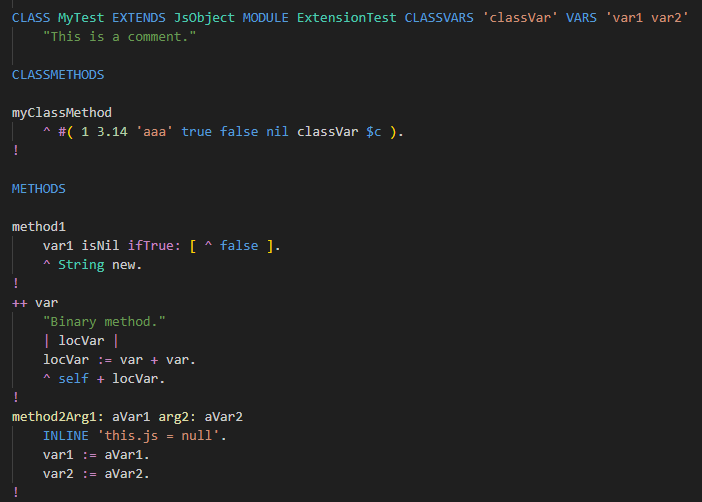
Explanation of syntax used:
-
CLASS: Is followed by the class name. EXTENDS: Indicates the base class.Objectis the root class.MODULE: The JS module this class should be put in.CLASSVARS: Variables of the class itself (not its instances). Like JS static class vars.VARS: Instance variables of objects created from the class, e.g.:MyTest new."This is a comment ...": Comments are put in double quotes.CLASSMETHODS: Following methods will be added to the (meta)class, like JS static class methods.METHODS: Following methods will be added to class instances, like JS regular class methods.
(Is the default method type if neitherCLASSMETHODSnorMETHODSis specified.)- Message sending types, ordered from highest to lowest evaluation precedence:
method1: Unary method, has no arguments.++ var: Binary (operator) method, has one argument.method2Arg1: aVar1 arg2: aVar2: Keyword method, has one or more arguments.
| locVar lv2 lv3 |: Local variables declaration.!: End of method- Constants
'aaa': String, uses single quotes1: Integer3.14: Floattrue,false: Booleannil: Nil singelton, like JSnull.$c: Character
var1 := 3: variable assignmentvar1 = 3tests for equality.
^ 42: Return a value.#( 1 3.14 'aaa' ): array with 3 values.[ 1 + 2 ]: block, like JS lambda functions.[ :a | :b | ^ a + b ]: block with 2 arguments returning sum from method (not block).
INLINE: Inline JS code, not transpiled.
ST variables can be accessed in it using the same name- Control flow statements in ST use messages and blocks from above.
1 + 2 = 3 ifTrue: [ 'Checks out' ]
Like JS: if( 1 + 2 == 3 ) { … }a > 0 ifTrue: [ 'Positive' ] ifFalse: [ 'Zero or negative' ]
Like JS: if( a > 0 ) { … } else { … }1 to: 10 do: [ :n | self log: n ]
Like JS: for( n = 1; n <= 10; ++n ) { … }[ a > 0 ] whileTrue: [ self log: a. a decrement ]
Like JS: while( a > 0 ) { … }[ self log: a. a decrement ] doWhile: [ a > 0 ]
Like JS: do { … } while( a > 0 )